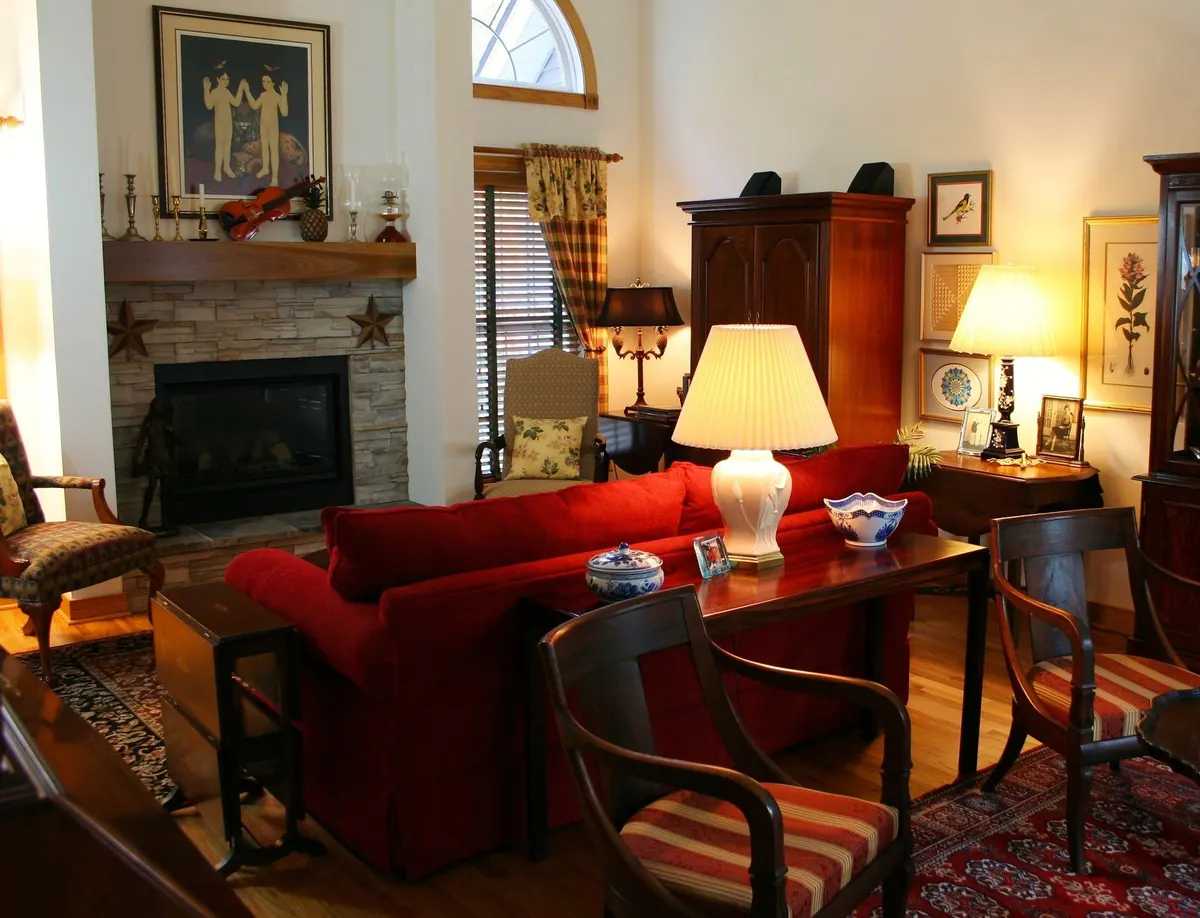
By four o'clock on a December afternoon in Scotland, the light has gone. That long stretch from teatime to bedtime is why living room lighting matters more here than almost anywhere else. Get it right and the room feels like somewhere to settle into for the evening. Get it wrong and you are sitting under a bright ceiling light that makes the whole house feel like a waiting room. You do not need a rewire or a designer to fix that. You need three layers of light working together.
Why one ceiling light never feels cosy
A pendant in the middle of the ceiling does one job: it lights the floor and the top of your head. Because it sits above eye level and throws light in every direction at once, it flattens the room. No shadows, no depth, no sense of where to sit. It is usually far too bright as well, and most of us leave it on simply because switching it off leaves everything in near-darkness.
Layering solves that. Instead of one big light, you build three: ambient for the general wash of light, task for whatever you are actually doing, and accent for depth and warmth. Each is dimmer than the pendant it replaces. Together they add up to something far better.
Ambient light: the base layer
Ambient light is the glow that stops a room feeling like a cave. It does not have to come from the ceiling. In fact, the most forgiving ambient light in a Scottish living room usually comes from two or three sources at different heights — a large floor lamp in the corner, a table lamp on the sideboard, a smaller one on a bookshelf.
Lower the ceiling light
If you live in a tenement flat with three-metre ceilings, that pendant is a long way from anywhere useful. You can drop it on a longer flex so the shade sits roughly 60–75cm above the coffee table, or swap the shade for a wide fabric drum that pushes light down and sideways rather than straight up. If you would rather not touch the wiring, leave the pendant for hoovering days and build the room around lamps instead. Nobody will notice it is off.
Task lighting: light where you actually sit
Task light is the layer you notice least until it is wrong. It should fall on the page, the knitting, the chopping board or the laptop — not on the wall behind you, and not into your eyes.
- Reading chair: a floor lamp with the shade sitting just below eye level when you are seated, angled over your shoulder.
- Sofa: a table lamp at each end, on a side table close enough to reach without standing up.
- Writing corner: a lamp placed to the side opposite your writing hand, so your own shadow does not fall across the paper.
- Sideboard or drinks tray: a small lamp to light the surface itself rather than the ceiling above it.
The general rule: the higher the shade, the more it glares; the lower it sits, the more light pools where you want it. Opaque fabric or ceramic shades are your friends here. Clear glass and bare bulbs are not.
Accent lighting: shadows, texture and warmth
Accent lighting is what makes a room look considered rather than merely lit. It picks out a picture, a plant, a stretch of stone wall or a piece of furniture, and it gives corners some depth.
This layer is cheap to get right. A small lamp tucked into a window recess lights the sill beautifully. A picture light above a print adds a soft wash down the wall. A low uplighter behind a houseplant throws leaf shapes across the plaster after dark. A jar of warm fairy lights on a bookshelf or a couple of candles on a tray does the same job for very little. Keep accent lights dim; they should be noticed second, after the room.
Bulbs, colour and dimming
The single biggest improvement most people can make is swapping bulbs. Look for warm white LEDs around 2700K. Anything at 4000K or above reads blue and clinical, and it will undo all your careful lamp placement in one flick of a switch. Some bulbs are sold as extra warm or dim-to-warm, which shift towards candlelight as you turn them down — lovely for evenings, though they cost a little more.
Check lumens rather than watts. A 400–500 lumen bulb is plenty for a table lamp; a floor lamp may want 800 or so. Oversized bulbs in small shades are the main reason lamps feel harsh.
Dimming
Dimmers change the character of a room more than any new lamp. If you are fitting one, choose a model designed for LED loads — often described as trailing edge or LED-compatible — and pair it with dimmable bulbs. Mismatched dimmers and bulbs are the usual cause of flicker and buzzing. If you would rather not touch the switch, plug-in dimmers, smart plugs and timers do most of the same work, and they let you set lamps to come on gradually as the light fades rather than all at once.
Practical wiring when the walls are stone
Older Scottish homes can be awkward: solid walls, few sockets, and sometimes no ceiling rose where you would like one. Most of this can be solved without an electrician.
- Rechargeable table lamps are now genuinely good and can sit anywhere, including on a windowsill.
- Plug-in wall lights run a slim cable down the wall and give you light without a floor lamp footprint.
- Self-adhesive cable trunking, painted to match the skirting, keeps trailing flexes tidy and out of the way.
- Switched extension leads behind the sofa let you turn three lamps off with one foot.
- Smart plugs and mechanical timers mean the room is lit before you walk in.
If you do want new sockets or properly wired wall lights, that is a job for a qualified electrician. Worth doing if you plan to stay put, and worth doing once rather than badly.
Five mistakes that flatten a cosy room
- One bright ceiling light doing all the work, with nothing else switched on.
- Cool white bulbs in every fitting, which make warm colours look grey.
- Bare bulbs and clear shades, which glare at seated eye level.
- Lamps placed across the room from where you sit, so you read in your own shadow.
- Everything on at full brightness at once, instead of two or three lights turned low.
Start with one corner
Do not try to fix the whole room in an evening. Pick the corner you sit in most, add one lamp at the right height, fit a warm bulb, and put it on a dimmer or smart plug. Live with it for a week and you will start to notice where the room still feels hard — a dark alcove, a corner that needs depth, a wall that would take a picture light nicely.
Build outwards from there, layer by layer. By the time the clocks go back, you will have a living room that feels warm at four in the afternoon and just as good at eleven at night, without a single bright ceiling light in sight.
Photo: Pixabay / Pexels